HoneyHive Recognized in the 2026 Gartner® Market Guide for AI Evaluation and Observability Platforms

HoneyHive is recognized by Gartner as an emerging leader on their 2026 Market Guide for AI Evaluation and Observability Platforms.
This recognition reflects a bigger shift happening within enterprises. AI observability and evals platforms are no longer optional tooling for developers. They're becoming foundational infrastructure for how enterprises deploy AI agents.
A new category of software
As agentic AI moves from experimental pilots to business-critical production, the challenge of non-determinism has become a defining problem for engineering and governance leaders alike. Gartner notes that "by 2028, 60% of software engineering teams will use AEOPs to build user trust, a massive leap from just 18% in 2025."
The teams investing in this infrastructure now are the ones who will be able to ship AI reliably when the rest of the market catches up.
As Mohak Sharma, our CEO, puts it: "Everyone's building agents. Almost nobody can tell you if they're actually working."
A unified approach to observe, evaluate, and govern any AI Agent across the AI Development Lifecycle
At HoneyHive, we've built around the belief that these three capabilities belong in one platform:
Observability gives teams real-time visibility into what their agents are actually doing in production, across complex, multi-step workflows where a single interaction can trigger dozens of agents across different teams and systems.
Evaluation provides structured, repeatable testing of AI behavior before and after deployment, covering hallucinations, regressions, tool use failures, and the subtle quality issues that only surface on real-world traffic.
Governance ties both together, enforcing controls, documenting decisions, and producing the evidence that enterprises need to meet regulatory standards and internal policies.
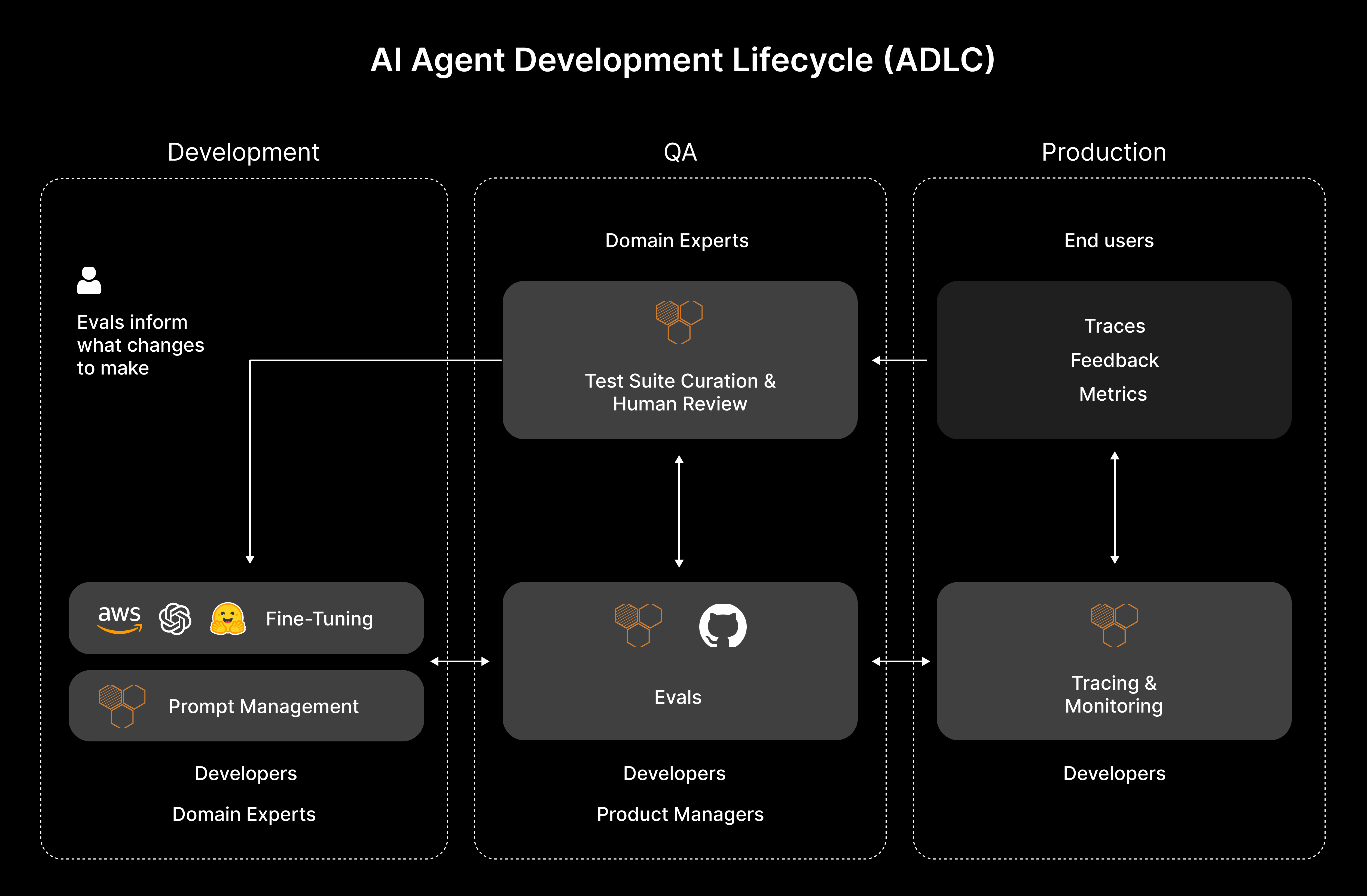
Rather than treating these as separate workflows, HoneyHive unifies them into a single platform.
What sets HoneyHive apart
HoneyHive was built for the reality that large enterprises face: hundreds of agents across dozens of business units, heterogeneous tech stacks, and regulatory complexity that can't be solved by bolting enterprise features onto a developer tool after the fact.
Observability
When a single customer interaction triggers ten or more agents across different teams, traditional monitoring can't answer basic questions: which agent caused this failure? What context did it use? How long has this been happening?
- Built for multi-agent complexity. Complex agents produce deep, branching traces that can span hours. Our wide-events database architecture handles this complexity at scale where traditional observability tools break down.
- OpenTelemetry-native. Integrates with any model provider, framework, or orchestration tool. No vendor lock-in. Whether teams build with code-first frameworks or no-code platforms, everything is visible from one place.
-p-1600.png)
Evaluation
Most teams test against synthetic benchmarks, ship to production, and then have no way to connect the issues they see back to the tests they ran. We close that loop.
- Close the loop b/w dev and prod. Turn real world traces into test datasets automatically. Every production failure, edge case, or flagged output becomes a test case you evaluate against going forward, so your benchmarks reflect what your system actually encounters, not what you imagined it would.
- Regression tracking and CI/CD integration. Automated testing in your deployment pipeline so failures get caught before production.
- Multi turn simulation and sub-agent evals. Pinpoint exactly which node or sub agent is underperforming, not just whether the overall output looks right.
-p-2600.png)
Governance
AI adoption without standardization is chaos. Every team builds differently, every workflow runs differently, and nobody can say for sure what's actually happening in production. HoneyHive gives governance and risk teams the control they need: every trace, eval, and human review decision is logged and auditable, so your AI systems operate within the standards your organization sets, not just the ones individual teams decide on.
- Full traceability. Every AI decision, evaluation, and human review is captured end to end, giving you a complete audit trail whenever regulators or internal stakeholders come asking.
- Alerting and policy enforcement. Define the guardrails your AI systems need to operate within, then monitor and verify they're actually being followed in production.
- Human review at scale. Structured annotation workflows for domain experts and compliance reviewers to validate outputs systematically, not through ad hoc spot checks but through a process rigorous enough to show a regulator.
Dhruv, our co-founder and CTO, puts it simply: "The simplest thing we solve is telling teams what their agents are doing and why. It sounds basic, but it's remarkably hard to quickly catch and fix what's going wrong in an AI's reasoning."
What's ahead
The line between testing, monitoring, and governance is blurring. Multi-agent systems aren't the future. They're happening now. And the bar for reliability keeps rising.
Dhruv knows where this heads: "Agents will be putting out a textbook's worth of reasoning just to answer one question. Who's going to read that?" The oversight problem only gets harder as agents get more capable. Our job is to make sure humans never lose visibility into how their AI systems work, even as those systems become dramatically more complex.
We're grateful for this recognition. Now back to work.
Click here to access the full report: Market Guide for AI Evaluation and Observability Platforms
Gartner Disclaimer: Gartner does not endorse any company, vendor, product or service depicted in its publications, and does not advise technology users to select only those vendors with the highest ratings or other designation. Gartner publications consist of the opinions of Gartner’s business and technology insights organization and should not be construed as statements of fact. Gartner disclaims all warranties, expressed or implied, with respect to this publication, including any warranties of merchantability or fitness for a particular purpose.